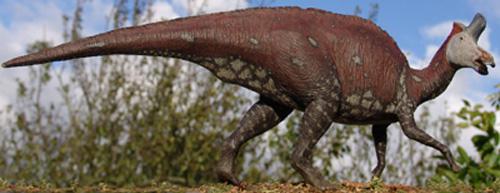



A lot can be said about the life of long extinct
animals, such as the dinosaurs, just by examining their
bones. By looking at fossils, scientists are often able
to state what a given animal fed on, whether it was quadrupedal
or bipedal, how fast it could move and many other things.
What is still very hard to obtain from fossilized remains
is evidence for the behavior of dinosaurs. The knowledge
we have has been obtained from such remains as eggs and
nests, but also skulls and trace fossils.
The most famous example of behavior that has become known
thanks to fossil
material is parental care in Maiasaura, a hadrosaur from
North America. By studying the nests found in Montana, US
palaeontologists were able to conclude that these hadrosaurs
did take care of their young. Nests themselves wouldn't
be too good evidence, as most reptiles build them and abandon
them next. What made the Maiasaura different was the fact
that many tiny pieces of egg shells were found in the nests.
They were most probably crushed to such a state by the young
dinosaurs, which therefore must have stayed in the nest
after leaving their eggs. This meant that they must have
been fed by their parents, who would bring them food straight
to the nest, for otherwise staying in it would mean starvation.
Recent osteological studies have also shown that the young
Maiasaura didn't have fully ossified limbs, which made it
difficult for them to walk longer distances. This would
explain why they stayed in the nests and it is also very
hard evidence for the hypothesis that out of the hadrosaurs
at least the Maiasaura were likely caring parents, although
things are not as evident as has been suggested first, and
some interpretations proved to be only moderately well supported.
Evidence for social behavior have also been found
in the form of trace fossils - tracks of several
sauropods traveling in the same direction have
been found and interpreted as evidence for herding
behavior. Bonebeds of hundreds of hadrosaurs and
ceratopsians also indicate that some dinosaurs
traveled in large herds. There are few other indications
of dinosaur behavior, which are so straightforward.
If any evidence is to be found it usually takes
tedious searching for, but is definitely worth
the effort. Simply mounting the huge, wonderful
giants of the past and reconsecrating their diet,
still leaves a major part of their world uninvestigated.
Birds are the living descendants of dinosaurs, and birds use many different sounds to communicate. Birds have another way to communicate that seems to have been shared by their dinosaur ancestors. Just as people recognize each other mostly by the way we look, birds and dinosaurs used feathers and, probably, colors to recognize each other. In the last twenty years, many dinosaurs with feathers have been discovered. Scientists can see that birds use different colored feathers for a variety of behaviors. They are used to attract mates, to identify individual members of a family or group, they are used to scare or fool attackers, and they are used to keep warm and dry. It seems likely that dinosaurs used their feathers for the same reasons. However, there is one way that most modern birds use their feathers that dinosaurs didn't. They use their feathers to fly.
Most dinosaurs didn't have feathers; instead, they may have used colors on their crests, frills or bodies to identify themselves to their friends and enemies. Other dinosaurs such as Velociraptor did have feathers. And there is a lot of evidence that very close family members of Velociraptor could use the feathers on their arms to help turn quickly and maybe even to glide, a behavior that eventually evolved into wing flapping and then flying.What else can fossils and dinosaur remains tell us about behavior? When scientists found a bunch of dinosaur nests with crushed egg shells all in one small area, it told them that dinosaurs were social animals that lived in groups. And because the eggs were crushed into very small pieces, it told scientists that the babies stayed in the nest for some time, long enough to crush the eggs. This means that the parents were taking care of the babies for some time after they were hatched, bringing them food and protecting them from predators. This is a very important thing to know when you are trying to learn about dinosaur behavior. The higher the level of parenting showed by an animal, the smarter it is considered. Also, several dinosaur skeletons have been found with serious injuries, such as broken legs, that have healed. This means that, while the injured dinosaur was unable to hunt for food, another dinosaur was bringing it something to eat. This is very complex social behavior.
Fossil footprints are another way scientists learn about behavior. These show that dinosaurs often traveled in large herds and in some cases even show how they hunted. And by studying the fossil remains of plants and the other animals that are found mixed in with dinosaur bones, scientists can create an even more detailed picture of dinosaur behavior.As is evident, different types of fossils can tell a trained scientist many different things about the behavior of a dinosaur. Bones, footprints, nests and many more bits and pieces of a dinosaur's life can create a big picture of life in the past.