


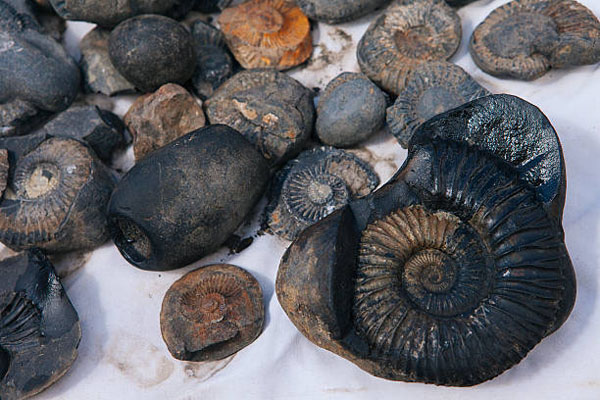
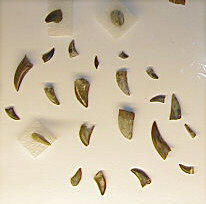
Trace fossils are those details preserved in rocks that are indirect evidence of life. While we are most familiar with relatively spectacular fossil hard part remains such as shells and bones, trace fossils are often less dramatic, but nonetheless very important. Trace fossils include burrows, track marks, coprolites, stromatolites and rhizoliths or rhizocretions.
The study of trace remains is called ichnology, which is divided into paleoichnology, or the study of trace fossil, and neoichnology, the study of modern trace remains. Another name for trace fossils is ichnofossils, taken from the Greek word ichnos, meaning "trace".
The science of ichnology is quite challenging, as many trace remains cannot be positively assigned to a specific organism. Further, trace remains such as burrows can make the work for paleontologists and geologists more difficult as they rework sediments, causing older strata to be mixed with younger ones. This can cause some confusion in interpretation unless viewed in context
Trace fossils are generally divided into five groups:
Domichnia are dwelling structures,
Fodichnia are feeding traces left by animals which eat their way through sediment,
Pascichnia are grazing traces made on the surface of the sediment, Cubichnia are resting,
Repichnia are surface traces of creeping and crawling.
Fossil remains of dinosaurs have been found in rock strata of every continent, indicating that they differed widely in structure, habitat, and diet. Their brain sizes varied, with some predators having brain-to-body ratios equivalent to those of some modern birds and animals. Many species built nests. Many theories regarding dinosaurs and their behavior are hotly debated by the experts. These include the debate over the grouping of birds with dinosaurs, the question of whether nonavian dinosaurs were cold-blooded (ectothermic) or warm-blooded (endothermic), the question of whether dinosaurs protected and nurtured their young in the nest after hatching or whether the young were mobile and self-sufficient at birth, and the reason for the disappearance of nonavian dinosaurs.
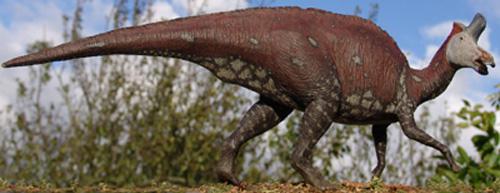
No complete fossil dinosaur has ever been discovered. Inferences must be made from fragments or pieces that have been compressed and distorted. Information about the diet has been gleaned from stomach contents and coprolites and by comparing the teeth to those of living animals, for example, relating the large grinding teeth of hadrosaurs to those of living herbivores. Fossilized dinosaur footprints, such as the track ways found at Davenport Ranch in Texas, have been interpreted as evidence that dinosaurs traveled in herds. What is known about dinosaurs is that, far from being evolutionary failures, they dominated their habitats for most of their 160 million years of existence .
Although all dinosaurs were originally classified in a single order, it was later discovered that the group contained two distinct types distinguished by structural differences. The pelvis in the saurischian (lizard-hipped) dinosaurs resembles that of still-extant reptiles, but in the ornithischian (bird-hipped) dinosaurs the pubic bone of the pelvis has forward and backward extensions that resemble those found in birds. It was later determined, however, that the backward-tilting hips of ornithischian dinosaurs and birds were the result of convergent evolution and not inheritance. Many other shared characteristics have been noted between birds and saurischians, and it is now believed by many paleontologists that modern birds are in fact extant dinosaurs of the saurischian order.
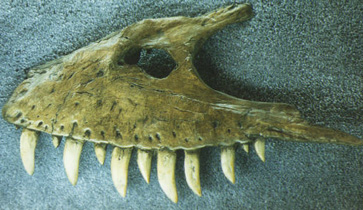
The jaws
and teeth of the two dinosaur orders also
differ. The saurischian
order, which includes
both herbivores and carnivores, has teeth around
the entire jaw or confined to the front of
the mouth. Ornithischians have "cheek
teeth"
along the sides of the jaw, but never in the
front; the bones at the front of the mouth sometimes
developed into the horny beaks typical of modern
turtles. All known ornithischians were herbivores.