

These are the quadrupedal herbivores like Apatosaurus, Brachiosaurus, and Diplodocus.
The general caharacters of Sauropodomorphas are:
• Fast and agile
• Carnivorous diet
• Sharp, slicing teeth or beak, and well-developed jaw muscles
• Clawed hands (usually with three main digits - exceptions include
the Tyrannosaurids, who lost the third digit)
• Bipedal walk
• Strong legs with bird-like, clawed feet
• Large eyes, indicating good eyesight.
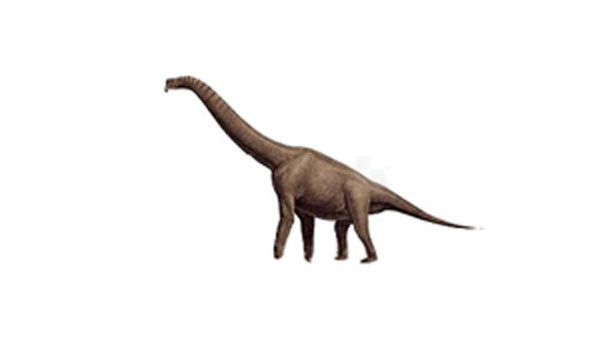
The types of these dinosaurs includes the following:
Apatosaurus:
Apatosaurus/Brontosaurus was one of the largest land animals that ever existed. The dinosaur Brontosaurus is now called Apatosaurus. This enormous plant-eater measured about 70-90 feet (21-27 m) long and about 15 feet (4.6 m) tall at the hips. It weighed roughly 33-38 tons (30-35 tones). Its head was less than 2 feet long; it had a long skull and a very tiny brain. This plant-eater had a long neck (with 15 vertebrae), a long whip-like tail (about 50 ft = 15 m long), a hollow backbone, peg-like teeth in the front of the jaws, and four massive, column-like legs. Its hind legs were larger than the front legs.Fossilized Apatosaurus footprints (called track ways) have been found (in Colorado, USA) that were about a yard wide. Apatosaurus could
have held its head at most 17 feet (5.4 m) off the ground (Parrish and Stevens, 1999). Allosaurus, which was the biggest meat-eater at that time in North America, was only 15 feet (4.6 m) tall. This afforded Apatosaurus protection from predators, since Allosaurus couldn't attach its head or neck, and probably had more sense than to attack its gigantic, clawed feet or whip-like tail.Strangely, Apatosaurus' nostrils were located on the top of its head. No one is sure what purpose this served. It used to be thought that this was a snorkel-like device for a water-dwelling animal, but this theory has been repudiated. Since Apatosaurus fossils have been found far from any water-dwelling fossils, it is now believed that Apatosaurus spent most of its time on land, far from large bodies of water or swamps.Apatosaurus held its neck more-or-less horizontally (parallel to the ground). The long neck may have been used to "mow" wide swaths of vegetation or to poke over or into stands of trees to get foliage that was otherwise unavailable to the huge, lumbering varieties of sauropods who could not venture into forests because of their size. Alternatively, the long neck may have enabled this sauropod to eat soft pteridophytes (horsetails, club mosses, and ferns). These soft-leaved plants live in wet areas, where sauropods couldn't venture, but perhaps the sauropod could stand on firm ground and browse in wetlands.Although many sauropods may have traveled in herds, bone beds of Apatosaurus fossils have not been found. Apatosaurus may have been a solitary animal. Sauropods' life spans may have been on the order of 100 years.
Brachiosaurus:
Brachiosaurus was one of the tallest and largest dinosaurs yet found. It had a long neck, small head, and relatively short, thick tail.Brachiosaurus walked on four legs and, like the other Brachiosaurids and unlike most dinosaurs, its front legs were longer than its hind legs. These unusual front legs together with its very long neck gave Brachiosaurus a giraffe-like stance and great height, up to 40-50 feet (12-16 m) tall.Brachiosaurus was about 85 feet (26 m) long, and weighed about 33-88 tons (30-80 tones). It had a claw on the first toe of each front foot and claws on the first three toes of each rear foot (each foot had five toes with fleshy pads). Brachiosaurus lived in the middle to late Jurassic period, about 156-145 million years ago, near the middle of the Mesozoic Era, the Age of Reptiles. Some dating estimates have Brachiosaurus surviving until 140 million years ago, during the dawn of the Cretaceous period.Among the contemporaries of Brachiosaurus were other giant Sauropods including Camarasaurus, Supersaurus, Ultrasauros, and Haplocanthosaurus. Brachiosaurus was a terrestrial animal. It was assumed for many years that giant sauropods spent most of their time in water, letting the water support their weighty bodies while breathing through their lofty nostrils. Now it is believed that they were fully terrestrial, just as Elmer S. Riggs, who first described Brachiosaurus, argued in a 1904 article. He believed, as most modern scientists do, that Brachiosaurus' feet and limbs were not broad enough to support the heavy animal in mud, that its back was flexible enough to support it on land, and that its chest was narrow and deep, which is insufficient for breathing underwater, and inconsistent with modern-day water-dwelling large animals (like hippos). Brachiosaurus was quadrupedal, walking on four legs. Unlike most other dinosaurs, the front legs were longer than the hind legs.
Diplodocus:
Diplodocus was a long-necked, whip-tailed giant, measuring
about 90 feet (27 m) long with a 26 foot (8 m) long neck and a 45 foot
(14 m) long tail, but its head was less than 2 feet long. It was among
the longest land animals ever. Its nostrils were at the top of its head
and it had peg-like teeth, but only in the front of the jaws. Its front
legs were shorter than its back legs, and all had elephant-like, five-toed
feet. One toe on each foot had a thumb claw, probably for protection.
A fossilized Diplodocus skin impression reveals that it had a row of spines
running down its back.Diplodocus was an herbivore (it ate only plants).
It must have eaten a tremendous amount of plant material each day to sustain
itself. It swallowed leaves whole, without chewing them, and may have
swallowed gastroliths (stones that remained in its stomach) to help digest
this tough plant material. It had blunt teeth, useful for stripping foliage.
Diplodocus lived in the late Jurassic Period, from 155-145 million years
ago. The late Jurassic was the time of the enormous sauropods, including
Camarasaurus, Apatosaurus, and Brachiosaurus. Also present were Stegosaurus,
Tuojiangosaurus, Allosaurus, Supersaurus, Coelurosaur, and many others.